Quotients
Definition 107.1.
Let and be an abelian group. is a left/right ideal if it is closed under left/right multiplication by elements of .
Let be a subgroup of the abelian group of a ring . Subgroups of abelian groups are automatically normal, so we have a quotient group , whose elements are cosets of . Further, we have a surjective group homomorphism
==What requirements should meet, in order to have a ring structure on , such that becomes a ring homomorphism?== If is a ring homomorphism, there is only one way to define a ring structure on :
Thus, there is only one sensible ring structure on , given by (note that if this operation is well defined, is, in fact, a ring). When is this operation well defined?
Claim 107.2.
The operation on is well defined iff is an ideal of .
Proof.
Assume the operation is well defined, making into a ring, and into a ring homomorphism. . The absorption properties are easily verified: for all and ,
Thus, is an ideal.
Conversely, assume is an ideal. Let .
which proves that the operation is well defined.□
Thus, is a ring, in such a way that the canonical projection is a ring homomorphism, iff is an ideal of .
The universal property of quotient groups provides the scaffolding for its analogue in : the needed (group) homomorphism exists and is unique by the group theoretic theorem; verifying it is a ring homomorphism is immediate.
Theorem 107.3(Aluffi (2009) III.3.8).
d9ba22Let be a two-sided ideal of a ring . Then for every ring homomorphism such that there exists a unique ring homomorphism so that the diagram
commutes.
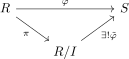
This allows for the canonical decomposition and the first isomorphism theorem for rings.
Correspondence and third isomorphism
Observe that the ideals of containing are in bijective correspondence with the ideals of the quotient : we already know that the subgroups of containing are in bijective correspondence with the subgroups of , viz., . It is easily verified that is an ideal of iff is an ideal of .
Theorem 107.4(Correspondence theorem, Artin (2011) 11.4.3).
629cc7Let be a surjective homomorphism with kernel . Let be an ideal of containing and be an ideal of . Then,
- is an ideal of .
- is an ideal of , and it contains .
- , and .
- If , then .
As in the case of groups, quotients by corresponding ideals are isomorphic:
Theorem 107.5(Aluffi (2009) III.3.11).
f12ed2Let be an ideal of a ring , and let be an ideal of containing . Then is an ideal of , and
Proof.
Since, Thm 3 gives us an induced ring homomorphism . Explicitly, . Clearly, is surjective.
Thus, is an ideal, and the stated isomorphism follows from the first isomorphism theorem.□
== is not a ring!==
Ideals
Algebra of ideals
Definition 107.6.
Let be a commutative ring with . Let be ideals of .
- . This is a subring of .
- .
- Clearly, .
- If , then .
Definition 107.7.
Let be an ideal of a ring . is said to generate if every element of can be written as a finite sum , .
Proposition 107.8.
- If and , then and .
- .
- .
[!Example]
Let or or . , . Show that .
Properties of ideals under homomorphisms
Proposition 107.9.
6a203e
The inverse image of an ideal under a homomorphism is an ideal.
The image of an ideal under a surjective homomorphism is an ideal.
Proof.
Let be a homomorphism.
Let be an ideal. Let . Then, , so . Next, , so . Thus, is an abelian group. Let . Then, , and , so is closed under left and right multiplication by .Let be an ideal. is clearly an abelian group. Let . Any element of may be expressed as . Since
is closed under left and right multiplication by .□
Analogous to this proposition from group theory.
For any ring with ideal , we have a natural surjective homomorphism : . If is an ideal in , then (the ideal generated by in ) is equal to , and is the ideal .
Proposition 107.10.
Let be a homomorphism. Let and be ideals such that . Then, is a homomorphism.
Proposition 107.11.
Let . Let be an ideal in . Let be the ideal in generated by . Then, is an ideal in containing .
If is an ideal of , is an ideal in contained in .
It follows that every ideal contains for some on considering the inclusion homomorphism .
Principal ideals
Let be any element of a ring. Then the subset of is a left-ideal of . Indeed, for all we have . Similarly, is a right ideal.
Definition 107.12.
A principal ideal is an ideal that is generated by a single element.
- A left principal ideal of is a subset of given by for some element .
- A right principal ideal of is a subset of given by .
- A two-sided principal ideal of is a subset of given by for some element , namely, the set of all finite sums of elements of the form .
When is commutative, the three notions coincide and are denoted . This is the principal ideal generated by .
The zero-ideal and the whole ring are both principal ideals.
Lemma 107.13.
If is a family of ideals of a ring , then the sum is an ideal of .
Definition 107.14.
If is any collection of elements of a commutative ring , then
is the ideal generated by the elements .
In particular,
is the smallest ideal of containing ; the elements of this ideal are of the form
for .
Definition 107.15.
An ideal of is finitely generated if for some .
Example 107.16.
5c702eLet be a commutative ring, and let . Let denote the class of in . Then,
This follows from Thm 5, since
Definition 107.17.
- A commutative ring is Noetherian if every ideal of is finitely generated.
- An integral domain is a PID (Principal Ideal Domain) if every ideal of is principal.
is clearly a PID.
Theorem 107.18.
2e8cc1If is a field, then is a PID.
Proof.
, however, is not a PID: the ideal cannot be generated by a single element.