Modules
Remark 108.1.
If , are abelian groups, then is also an abelian group, with addition defined pointwise.
(In fact, it is sufficient for to be commutative for to be a group. Even better: If is a commutative group, then is a commutative group for all sets !)
Anyway, if , further allows its constituent morphisms to be composed, making it a ring with multiplication defined to be composition. See Aluffi (2009) III.1.1.
The theory of modules is based on the observation that is a ring for every abelian group . Recall that we defined group actions as group homomorphisms from a fixed group to the group of automorphisms of a set. Analogously, the left-action of a ring on an abelian group is a homomorphism of rings . We say that makes into a left module. The uncurried version has type , with the relation between them given by . is denoted by . An equivalent definition using follows.
Definition 108.2(Module).
2e9663Let be a ring (with ). A left module is an additive abelian group with the operation , with the following axioms
(1) and (3) are due to being a (ring) homomorphism; (2) is being a (group) endomorphism of .
Ditto for right module. Similar to right group actions, a right -module structure may be identified with a left- module structure, where is the ‘opposite ring’ obtained by reversing the order of multiplication. However, unlike the case for groups, and are not isomorphic in general.
Some trivial facts:
- ;
- ;
- .
Proposition 108.3.
04c10aEvery abelian group is a -module, in exactly one way.
Proof.
Definition 108.4(Module homomorphisms).
db10f5A homomorphism of -modules is a homomorphism of abelian groups which is compatible with the module structure. That is, if are -modules and is a function, then is a homomorphism of -modules iff
- , for all ;
- , for all and .
Given a ring , the identity is an -module homomorphism. Clearly, the composition of two -module homomorphisms is an -module homomorphism. Thus, -modules form a Category, denoted by . The trivial group has a unique module structure over any ring and is a zero-object in , that is, it is both initial and final. It can be easily verified that a bijective homomorphism of -modules is an isomorphism in . By Prp 3, the category is the same as the category .
Proposition 108.5.
e65692Let be rings and be a ring homomorphism. Then, is an module.
Proof.
Let be defined by (it is easily seen that is indeed a group homomorphism for all ). We need to verify that is a ring homomorphism:
So, is a ring homomorphism, making (the underlying group of) an -module. Concretely, the action is .□
In Prp 5, if we require to be commutative and to map to the center of , the ring operation in become compatible with the -module structure:
Such a structure is called an -algebra.
Definition 108.6(-algebra).
419c68Let be a commutative ring. An -algebra is a ring homomorphism such that is contained in the center of .
Def 6 defines an -algebra as a ring with compatible -module structure; it can also be thought of as an -module with a compatible ring structure.
Remark 108.7.
e7f7dbRecall that for , , with the group operation inherited from : . Note that commutativity is required for this prescription to yield an element in :
The remaining group axioms are easily verified.
Similarly, if is a commutative ring, each set can be seen as an element of . Indeed, let and be -modules. Since homomorphisms of -modules are in particular homomorphisms of abelian groups,
The operation making into a group clearly preserves , so the latter is an abelian group. For and , the prescription defines a function . This function is an -module homomorphism if is commutative, because
Thus, we have a natural action of on the abelian group , and it is immediate to verify that the associated map is a ring homomorphism, making into an -module.
Submodules and quotients
Definition 108.8.
A submodule of an -module is a subgroup of preserved by the action of on .
Example 108.9.
- itself is a left -module; the submodules of are the left ideals of .
- Both the kernel and the image of an -module homomorphism are submodules (of and , respectively).
- If is in the center of and is an -module, then is a submodule of . If is any (left-) ideal of , then is a submodule of .
If is a submodule of , then it is in particular a normal subgroup of the abelian group , so is an abelian group. As usual, we are interested in the question: what properties must have so that the natural projection is a -module homomorphism?
If is a homomorphism, we have
for all . Thus, we are forced to define the action of on by
It turns out (as can be easily verified) that this prescription defines a -module structure on for all submodules . This is very similar to what happens in , where every subgroup is normal - unlike in or , being a kernel poses no restriction on the relevant substructures.
The -module is called the quotient of by .
Example 108.10.
ec98bcIf is a ring and is a two-sided ideal of , then all three of , , and the quotient ring are -modules. There are two ways to view the module : As the module arising from the canonical projection and Prp 5, or as the quotient of the -module by its submodule . The latter works even when is not commutative and is just a (say) left-ideal: the quotient is not defined as a ring, but it is defined as a left-module. The action of on is given by left multiplication: .
The universal property and isomorphism theorems are what you’d expect; see Aluffi (2009, pp. 161, 162).
Proposition 108.11.
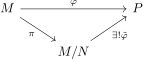
7d0f31Let be a submodule of an -module . Then for every homomorphism of -modules such that there exists a unique homomorphism of -modules such that the diagram
commutes.
Proposition 108.12.
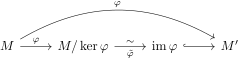
Every -module homomorphism may be decomposed as follows:
Proposition 108.13.
7c2d63Let be a submodule of an -module , and let be a submodule of containing . Then is a submodule of , and
Imitate proof of Thm 107.5.
Finitely generated modules
Definition 108.14(Finitely generated module).
db6ba2The left -module is finitely generated if there exist in such that for any , there exist with .
Warning
being a finitely generated abelian group is not the same thing as it being a finitely generated -module. is not finitely generated as an abelian group, but is finitely generated by as an -module.