Jordan canonical form
Let be a -vector space, and . The goal is to find a basis for in which the matrix of has a ‘nice’ form. We assume that is algebraically closed, but we only really require that the characteristic poly
Recall that to make a -module an -module, we need to specify a ring map . Note that any ring is a -algebra.
Now, let be a -module. To make a -vector space, we need to specify a ring map . Since is a field, must be injective.
, the set of -linear maps from to , is clearly a subset of . Recall that is -linear iff for all and for all . This can be written as for all . Therefore, is the centralizer of in . Since is commutative, lies inside the centralizer of , so .
Next, let be a field, and a finite dimensional -vector space. Consider the -algebra . To make a module, we need to specify a ring map .
Let . The mapping gives us a map , with the scalars being mapped using .
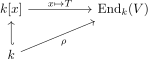
This makes into a -module, compatible with the -vector space structure of when is considered to be a subring of . Thus, the basis that generates as a -vector space will continue to generate as a -module, making a finitely generated -module.
Example 402.1.
Suppose ; by Exm 108.10, has a natural -module structure. What should the that gets mapped to be to realize this module structure as a map ?
Firstly, as a -vector space, with basis . In the natural -module structure, acts on these elements like so:
Thus, in the basis , is given by the matrix .
Remark 402.2.
eddb40Suppose as -modules, where and are -submodules of the -module . Clearly, and are also -submodules of the -module . The conditions and , being properties of as an abelian group, are not impacted by the module structure on . Thus, the equation continues to hold in .
The converse is not true. For example, , as a -module, cannot be written as a direct sum of two proper submodules1. But as a -vector space, it is isomorphic to .
Proposition 402.3.
is a torsion -module.
Proof.
Proof.
This proof isn’t ‘canon’, since we’d like to prove Caley-Hamilton using this development later.
Let be the characteristic polynomial of . Then, by C-H, . Thus, annihilates as a -module.□
Using Thm 394.7 and Thm 398.12, we can now write
as -modules, where the ‘s are irreducible polynomials (and not necessarily distinct) and for all . Call the entity on the RHS , and let be an isomorphism. Using , we can obtain subspaces such that
Note that since is a -module homomorphism, multiplying by in retains the meaning of ‘applying ’:
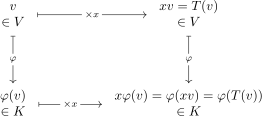
We will implicitly identify elements of with their isomorphic counterparts in .
Proposition 402.4.
Suppose as -modules. Let be -basis for . Then with respect to , is given by a block diagonal matrix
where and .
Proof.
Firstly, we have as -vector spaces, by Rmk 2. Next, since and are -submodules, we have when for . In other words, and are -invariant subspaces of . It follows that the matrix of is block diagonal in the basis .□

Thus, if are -bases for the summands , is given by the matrix
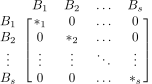
Thus, by choosing our basis vectors from the invariant subspaces provided by (E1), it is possible to get the matrix of to be in block diagonal form. We now seek a specific choice of such that the blocks themselves have a ‘nice’ form.
We now assume is algebraically closed, so all primes in are of the from for some . The summands in (E1) now take the form
An immediate candidate for is . However, this is not the basis we are looking for.
Example 402.5.
In general, the basis
for of the form yields the matrix
with ‘s on the diagonal and ‘s below the diagonal:
This is about as ‘nice’ as matrices get. Satisfied with our work, we make the definition
Definition 402.6(Jordan block).
d71679A Jordan block of size and eigenvalue is an matrix of type (E3).
Definition 402.7(Jordan canonical form).
68d070A matrix is said to be in Jordan canonical form if it is block diagonal with Jordan blocks on the diagonal.
Theorem 402.8.
261664Let be an algebraically closed field. Let be a finite dimensional -vector space. Let be -linear. Then there exists a basis of with respect to which is given by a matrix in Jordan canonical form.
Proof.
Footnotes
-
; use Thm 398.12. ↩
-
This is abuse of notation; when working in the wider context of being a subspace of , and would be more accurate, albeit a bit clunky. ↩