A classification of modules over Euclidean domains
Let be a Noetherian ring, and be a finitely generated -module with generating set . The kernel of the map given by Prp 373.14 is exactly all the -linear relations among . Since is Noetherian by Prp 389.3, is finitely generated, say by elements. So, there exists a surjective map . Let be the composite .
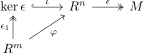
Observe that
Thus, for Noetherian and a finitely generated -module , there exists a -module homomorphism such that . Assuming the standard basis for and , can be represented by a matrix with entries in , which we call a presentation matrix for .
Definition 391.1.
An -module is finitely presented if for some positive integers there is an exact sequence
Such a sequence is called a presentation of , and the matrix of is called a presentation matrix for .
We have just shown that finitely generated modules over Noetherian rings are finitely presented.
For example, the -module is presented by the map given by , or equivalently by the matrix .
With the basis of being , the columns of the presentation matrix of form a complete set of relations among the generators of (a set of relations is said to be complete if every relation is a linear combination of with coefficients in ).
Let be the matrix of . We can edit in several ways while keeping unchanged. We can change the bases for or :
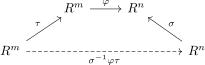
Thus, if happens to be a euclidean domain, we can use Prp 405.3 to assume WLOG that is in Smith normal form. But this is not the whole story. Two different homomorphisms , may have isomorphic cokernels, even if they act between different modules. Case in point: if has a column of zeroes, we can remove the column - the corresponding homomorphism clearly has the same cokernel as . Thus, we can assume WLOG that is of the form
where and . Finally, if is a unit, we have
where corresponds to the matrix obtained from by dropping column and row . We can therefore assume that (and hence all for ) are nonunits. now takes the form
And that’s it! We’ve shown that when is a euclidean domain, any finitely generated -module can be expressed as a direct sum of cyclic modules. In fact, this result is true over any PID, as we will prove in the coming lectures.
Prp 2 summarizes our observations on cokernel preserving matrix manipulations.
Proposition 391.2(Artin (2011) 14.5.7).
2296e1Let be an presentation matrix for a finitely generated -module . The following matrices represent the same module :
, with ;
, with ;
A matrix obtained by deleting a column of zeroes from ;
If the th column of is , the matrix obtained from by deleting row and column .
Proof.
Let be the map that describes, interpreted using standard bases.
corresponds to changing the basis of to . Note that the map remains unchanged.
corresponds to changing the basis of to . Again, is not impacted.
A column of zeros corresponds to a trivial relation, which can be omitted. More concretely, dropping a zero column gives us a map with , so . Thus, the matrix of presents .
A column of equal to corresponds to the relation . The zero element is useless as a generator, and its appearance in any other relation is irrelevant. So we may delete from the generating set and from the relations.□
Decomposition of finitely generated modules into torsion and free components
Our first step toward a classification theorem for modules over PIDs1 (Thm 407.2) is showing that a finitely generated module over a PID is a direct sum of a free module and a ‘torsion’ module.
We’ve already classified finitely generated free modules over integral domains, so it makes sense to begin by examining how a module can fail to be free. There are several ways this can happen, with having torsion being one of them.
Definition 391.3.
73f393Let be an integral domain, and an -module.
- A nonzero element is called a torsion element if is linearly dependent, i.e, there exists nonzero such that .
- We say is torsion-free if does not contain any torsion elements.
- We say is a torsion module if all elements of are torsion elements.
- . Note that is a submodule of .
Note that free modules are torsion-free.
Lemma 391.4.
Submodules and direct sums of torsion-free modules are torsion-free. Free modules over an integral domain are torsion-free.
Here’s another mechanism in which a module may fail to be free.
Example 391.5.
Let , and let . Then is not a free -module. More generally, any nonprincipal ideal of an integral domain is a torsion-free module which is not free. Indeed, if were free, its rank would have to be at most, by Lem 373.8; thus one element would suffice to generate , and would be principal.
Lemma 391.6.
4998deLet be a finitely generated -module. Then, is torsion free (and finitely generated).
Proof.
If , let denote its residue class mod . Let , be such that . Then , and hence there exists nonzero such that . Hence and , thereby proving that is torsion free.□
Analogous to the case for abelian groups, submodules of free modules are free of rank less than or equal their parent.
Lemma 391.7(Lang (2002) 3.7.1).
84b3e5Let be a free module over a PID, and a submodule. Then is free, and its dimension is less than or equal to the dimension of .
Lemma 391.8(Isaacs (2009) 16.28).
fdca90Let be a PID, a finitely generated torsion free -module. Then is free.
Proof.
Some general observations:
- By Prp 114.11, is a UFD. Therefore, we can talk of prime factorizations of elements of .
- By Cor 389.4, is Noetherian.
We work by induction on the number of generators for . If , then and the result is trivially true. Assume and fix a generator of . We consider singly generated submodules of the form for elements , and we write . By Prp 389.1.2, has a maximal element, say . Note that is generated by elements.
We claim that is torsion free. In other words, we must show that if is such that for some , then . Let be such an element, with for some . If and have any common prime factor , we can write , , and . Since is torsion free, we must have . Therefore, we can assume WLOG that and are coprime. By Rmk 114.6, we can write with .
Write . Thus, we have . Since is clearly a member of , we deduce by the maximality of . It follows that . Since , this yields . So, , and is torsion free.
We have the short exact sequence
By the induction hypothesis, is free, and hence projective. By Cor 386.3 and Conrad (n.d.) 2.1, the sequence splits, and we have . Since is torsion free, is isomorphic to the free rank 1 -module . It follows that is free.□
Proof.
From Lang (2002) 3.7.3; Uses Lem 7.
Let be a generating set for . Let be a maximal linearly independent subset of . For , there exist elements , not all , such that
Then , lest we contradict the linear independence of . Hence lies in the free submodule of generated by . For each , we can find , , such that . Let be the product. Then and . Since is torsion free, the map is an injective homomorphism, and is isomorphic to its image under this map. We conclude form Lem 7 that is free.□
For example, is a non-free torsion free module. is not a finitely generated module.
Theorem 391.9.
1a540bLet be a PID, and a finitely generated -module. Then .
Proof.
We have the short exact sequence
Again, by Lem 6 and Lem 8, is free, and hence projective. By Cor 386.3 and Conrad (n.d.) 2.1, the sequence splits.□
Thus, every finitely generated module is a direct sum of a finitely generated torsion module and a finitely generated free module. Free modules have a simple structure that we understand. It remains to study finitely generated torsion modules ( must be finitely generated since it is a submodule of , which is Noetherian).
Footnotes
-
Aluffi does a brilliant job of motivating why we’re interested in PIDs here using free resolutions - see Aluffi (2009, pp. 342–344), in particular VI.4.11. ↩