Projective modules
Proposition 386.1.
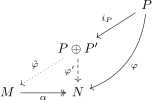
eba5edLet be a surjective -module homomorphism, and let be a -module homomorphism with free. Then, there exists an -module homomorphism such that the following diagram commutes.
Proof.
Let be a basis of . For all , let be such that (possible since is surjective). Extend the map to an -module homomorphism . It is now clear that .□

Modules with the property described in Prp 1 are called projective modules.
Definition 386.2(Projective modules).
544d97A -module is said to be projective if for all surjective and -module homomorphisms there exists an -module homomorphism such that the following diagram commutes:

Clearly, free modules are projective.
Warning
Corollary 386.3.
d32b0cLet be a surjective -module homomorphism with projective. Then there exists an -module homomorphism such that .
Proposition 386.4.
c05711Let be a projective module. Let be a -module homomorphism, and be supplied by Def 2 such that . Then,
is surjective and is injective.
.
Proof.
is just set theory.
Let . Write . Since , we have . So, can be expressed as . Next, let and let be such that . Then, . Thus, . We are done by Thm 99.1.□
Proposition 386.5.
- If is projective, there exists such that for free .
- If is projective, then and are projective.
Thus, is projective iff it is a direct summand of a free module.
Proof.
follows from Prp 373.13 and Prp 4.
For , Let and be given as in Def 2. The trivial map from to together with determines a map such that . Since is projective, there exists such that . Thus, . Thus, is projective.
A symmetric argument shows that is projective.□
Rank of a free module, à la Kummini
Here’s how Kummini proved Thm 373.9⇒.
We first prove the invariance of basis cardinality for vector spaces.
Proposition 386.6.
1fd2ebLet be a -vector space with bases and . Then .
Proof.
We have seen the case when and are finite in Thm 74.2. The case of one being finite and the other being infinite is ruled out by Lem 74.5. So, assume and are infinite.
For all , there exists a finite subset of such that . Therefore, generates . Since no proper subset of can generate , we have
Since each is finite, basic set theory says . Reverse the argument to obtain .□
Proposition 386.7.
f64b92Let be a free -module with bases and . Then .
Proof.
Let be an ideal of . Define to be the submodule of generated by :
Observe that is an -module (this is not true in general; see Rmk 8): If ,
For and , we may denote by and by .
We now claim that is a basis of as an -module.
Firstly, if generates as an -module, then generates as an -module, and hence as an -module: For , with a little abuse of notation we can write
Thus, generates as an -module.
It remains to show that is linearly independent. Fix . Let for , for , such that
Equivalently, . Thus, can be expressed in the form with and . Replacing each with its expression in the basis , we get
Since is a basis, we have , and (WLOG) and . Thus, , and hence for all 1.
Using Thm 111.1, let be a maximal ideal of . This makes a field and an -vector space. We have shown and (similarly defined) are bases of over . The final result follows from Prp 6.□
Remark 386.8.
b14fe9Every module is naturally an -module: . In general, if is a ring map and is an -module, we can give an -module structure by . This is the unique module structure for as an module which is compatible with .
The converse is generally false. For example, considered an an -module cannot have a compatible -module structure for any nonzero ideal . If is nonzero, then evaluates to under the -module structure, while the action of , forced to be the trivial action in any -module structure on , yields .
However, if is an -module such that for all and for all , 2, then the prescription
makes a compatible -module.
Let and be -modules. Let . When can we say ?