Free groups
Refer Balsdon et al. (n.d.), Sury (2010).
See Robinson (2015) for an interesting application of free groups.
Intuitively, a free group is a group which has no nontrivial relations among its elements - it satisfies the bare minimum requirements to be called a group (the group axioms) and nothing more.
Definition 102.1.
1e47e5Given a non-empty set , and a map into a group , the pair is said to be a free group on the set if, for any function to any group , there is a unique homomorphism such that . When is an inclusion, we call the unique extension of to .

Proposition 102.2.
If is a free group on a set , then
must be injective.
is free on .
generates .
Proof.
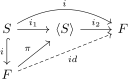
and are clear, so . Let be the inclusion . The unique extension of to is clearly the identity 1. Consider the inclusions and . Clearly, . Let be the unique extension of to . Then, we have , forcing . Since is an inclusion, this forces .
□
Constructing a free group on any arbitrary set
To construct a free group, start with an arbitrary set, say . Let be the set that contains the symbols and for every , ., . The elements of are called symbols. Define a word to be a finite string of symbols, in which repetition is allowed. Let be the set of all words along with the empty string . Define the product operation on to be concatenation. Obviously, is not a group, since inverses do not exist (yet).
If a word looks like for some , we may agree to “cancel” the two symbols and . Call a word reduced if no such reduction can be made. Starting with any , we can make a finite sequence of reductions to arrive at a reduced word , which is called the reduced form of . There may be more than one way to arrive at the reduced word. If we want the notion of a reduced word to be well defined, we must ensure that all paths lead to .
Lemma 102.3.
There is only one reduced word for a given word .
Proof by induction on (easy). See Artin (2011, p. 211).
Define an equivalence relation on by if and have the same reduced word. Next, observe that products of equivalent words are equivalent, that is, and imply . Therefore, it follows that the equivalence classes of words can be multiplied.
Lemma 102.4.
The set of equivalence classes is a group, with the law of composition induced from multiplication in .
Proof.
The facts that multiplication is associative and that the class of the empty word is an identity follows from the corresponding facts in . Also, for any , is clearly its inverse.□
Let . Defining the map by , let us show that is free on .
Proposition 102.5.
383842is free on .
Proof.
Let be a map into any group. Let , and the image of in be denoted by . from Def 1, if it exists, must agree with on , that is, . Since generates , this can be uniquely extended to a homomorphism .□
Thus, given a set , we have constructed a free group on . We will now show that free groups constructed on sets of the same cardinality are isomorphic.
Rank of a free group
Proposition 102.6.
0409cdIf , then .
Proof.
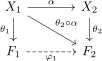
Let be an isomorphism, and , be free groups on and respectively. Let and be the unique homomorphisms given by Def 1 corresponding to and respectively.
For all ,
Therefore, makes this diagram commute:
Since the identity also makes the above diagram commute, it follows that . Similarly, . Thus, .□

The converse is also true: isomorphic free groups must be on isomorphic sets.
Proposition 102.7.
cb59c5If , then .
Proof.
Consider the sets and of group homomorphisms to the field . These sets are vector spaces over with bases and respectively. Fixing an isomorphism , we have an isomorphism of -vector spaces from to given by 2. Thus, their bases must have the same cardinality, which proves .□
In light of Prp 6 and Prp 7, one may define
Definition 102.8.
The rank of any free group is the cardinality of a set on which it is free.
Generators and relations
Definition 102.9.
A relation among elements of a group is a word in the free group on the set that evaluates to in .
The following should be easy to see:
Proposition 102.10.
Let be a subset of a group . There exists a unique smallest normal subgroup of which contains , called the normal subgroup generated by . If a normal subgroup of contains , it contains . The elements of can be described as follows: Let be the set consisting of elements and with . An element of is in if it can be written as a product of some arbitrary length, where each is a conjugate of an element in .
Definition 102.11.
Let be the free group on a set , and let be a set of elements of . The group generated by with relations is the quotient group , where is the normal subgroup of generated by . is denoted by .
Note that is precisely the set of words in which equate to the identity in . Let be the set consisting of elements and with . Let be the set of all conjugates of the members of : . Observe that any word in which evaluates to the identity can be expressed as a product of the elements of . For example, if , we know that the word evaluates to the identity in . It can be represented as a product of members of as
Now, for , consider the coset . These are a set of words whose equivalence can be established using the relations (observe that since is normal, contains every possible word equivalent to that you can think of: ). Thus, the cosets of in correspond to the distinct words in the group , modulo the relations in .
Theorem 102.12.
Let be a group and . Let be a set of relations satisfied by the elements of in . Let be the free group on , and be the normal subgroup of generated by . Let . Then, there is a canonical homomorphism which is
- surjective iff generates ;
- injective iff every relation among the elements of is in . In other words, is injective iff .
If is bijective, we say forms a complete set of relations among the generators , and .
Proof.
Def 1 gives us a homomorphism with . Clearly, . Since is a normal subgroup and thus is closed under the operations we used to construct , must also be contained in . The universal property of quotient groups gives us a map . This is the map .
is obvious; to see , assume there exists a relation among the elements of which is not present in . Then, and will be distinct elements of . However, since both and will be contained in , we have .□
Corollary 102.13.
A group is finitely generated iff it is a quotient of a finitely generated free group.
Proof.
A quotient of a finitely generated group is finitely generated (the image of the generators generate the image). Conversely, let be a finitely generated group, say generated by the finite set . Let be the free group generated by . The homomorphism supplied by Def 1 is the identity on , making it surjective. Therefore, .□