Tensor products
See also Bourbaki (1974) ch 3, 4
Definition 418.1(Bilinear map).
Let be -modules. A map is called -bilinear if and are -linear for all and .
Note that itself is not linear.
Definition 418.2(Universal property of tensor products).
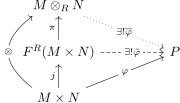
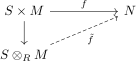
2dca86Let be -modules. We call a pair the tensor product of and , where is an -module and is -bilinear, if for all bilinear , there exists unique -linear such that the following diagram commutes.
We denote by .

I do not know where you got the idea from, but is not an inclusion!
Definition 418.3.
9b5c79Let and be -modules. Denote by the quotient module of the free -module with the set as a basis modulo the submodule generated by
Endow it with the map obtained by composing the set map with the natural projection onto . The element (that is, the class of modulo ) is denoted .
Proposition 418.4.
Let and be -modules. from Def 3 satisfies the universal property in Def 2.
Proof.
It is evident that defined an -bilinear map.
If is any -linear map, we have a unique induced -linear map from the free -module, by the universal property of the latter.
It is easily seen that is contained in . For instance,
By the universal property of quotients, there exists a unique -module homomorphism such that .
How do we know that is unique? Well, suppose is another map such that . Since , we have . This forces , which then forces !□
Warning
Elements of the form are called pure tensors. Not every element of the tensor product is a pure tensor! Pure tensors are nevertheless very useful, as a set of generators for the tensor product. For example, if two homomorphisms coincide on pure tensors, then .
Basic properties
Proposition 418.5.
Let and be -modules. If generates and generates then generates .
Proposition 418.6.
Let be -modules. Let be -linear. Then there exists an -linear map
More generally, if is -linear then there exists -linear map
Proof.
It is easy to verify that the map defined by is bilinear. The universal property then yields the required -linear map.
□
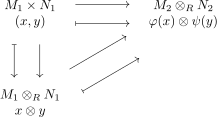
Since the diagram
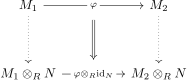
clearly commutes, it is evident that
Proposition 418.7.
is a functor; it is defined by and .
Proposition 418.8(The Hom-Tensor adjunction).
5f390dConsider the three functors defined by
These are naturally isomorphic. In particular, if we consider the covariant functors given by and , we have
i.e, and are adjoint. In words, the tensor product is left adjoint to .
Proposition 418.9.
The map defined on pure tensors by is an -module isomorphism.
Proof.
The map defined by is -bilinear. It is easily seen that the induced map is bijective.□
Proposition 418.10.
The tensor product is associative: .
Proof.
For fixed , define a bilinear map by
The universal property induces a linear map such that for every , . Next define the bilinear map by
Pass this map through the universal property to obtain a -linear map which maps pure tensors as . We can repeat the same construction to obtain an inverse .□
Remark 418.11(Universal property of-fold tensors).
1e6488Thus, we can talk of for any . The universal property of tensor products extends to -linear maps in the obvious way. We’ll work out the details for threefold products; higher products are handled by induction. Suppose we are given a trilinear map . For each , is a bilinear map. The universal property gives unique linear maps for each . Using these, we can define a bilinear map by
The universal property gives a unique linear map .
Proposition 418.12.
af3762The tensor product distributes over direct sums, i.e,
.Proof.
Consider the exact sequence
Since tensor is right exact, we get that
is exact; we need to show that is injective, since tensor products usually do not preserve that. This follows from functoriality: , so , so must be injective. Thus,
is exact; furthermore, while proving injectivity, we have also shown than has a left inverse. Thus, the above sequence is a split exact sequence, and we are done.□
Remark 418.13.
Arguing as in the proof of Prp 12, we can show that ==tensor preserves split exact sequences==.
Proposition 418.14(Tensor is right exact).
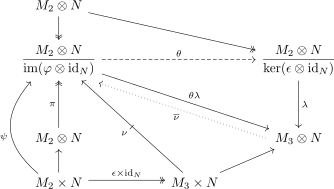
Let be -linear. Then .
In other words, given an exact sequence
the following sequence is also exact:
Equivalently, the functor is right exact.
Proof.
- Since is surjective, it is easy to see from the definition of that it is surjective too.
- Since , functoriality yields , so .
We need to show that the containment above is in fact an equality.
The mapping property of quotient modules gives us . Since is surjective, is an isomorphism. We contend that is an isomorphism; we will show this by constructing an inverse.
First, suppose that are such that . Then,
Thus, maps the entire set to a single element; we can thus define to be the composite . It is clear that is linear in the second slot. It is also linear in the first slot: if and are such that and , we have
Thus, is bilinear; let be the map induced by the universal property.
We contend that . Indeed, let . Let be such that . Then, . Now,
Similarly, it is evident that . We are done.□
Proof.
We know that tensor is left adjoint; it thus preserves colimits. In particular, it preserves cokernels.□
Proposition 418.15(Upgrading structure, I).
931795Let be an -algebra () and be an -module. The -module structure of can be extended to that of an -module, with the action of defined by
also satisfies the following upgraded universal property: for all -modules and maps which are -bilinear and -linear in the first slot, there exists a unique -linear map which makes the following diagram commute.
Proof.
We know that is an -module; we are attempting to upgrade its structure to that of an -module. To so this, we need to define an -action on . Say we define
Note that we need to first check that this is well defined: if , then we must have . It suffices to show that if , then . Here’s what we will do: we will show that the map defined by its values on pure tensors as is well-defined (do you see why this accomplishes our goal?). Start with defining a map by ; this is clearly -bilinear. Using the universal property of tensor products in , we get a map which maps pure tensors as - exactly what we want1!
Okay, so we have a well defined action of on . We are not done yet - we still need to show that this action is an
- abelian group homomorphism for each , and
- the map is a ring homomorphism.
In this case, it is much easier to check that , , . That this -module structure extends the preexisting -module structure on is evident.
As for the upgraded universal property, we first use the universal property of tensor products in (recall: -modules can be seen as -modules, -linear maps as -linear maps) to get an -linear map . We then show that is actually -linear; this easily follows from the hypothesis that is -linear in the first slot.□
Corollary 418.16.
Suppose that
is exact; then
is exact.
Proposition 418.17(Upgrading structure, II).
Let be -algebras: there exist ring maps , , and means is a ring homomorphism such that
commutes. We’ve seen that . We can upgrade it to an -algebra: the multiplication makes it into a ring, and the map given by
Proof.
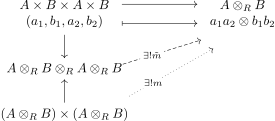
To show that the multiplication defined above is indeed well defined, by use the universal property from Rmk 11:
It remains to check that and make into a ring□

Proposition 418.18.
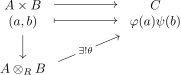
, along with the -algebra maps2 , and , , is the coproduct of and in .
Proof.
It is clear that the coproduct maps specified are indeed -algebra maps.
We have to show that satisfies the universal property of coproducts in . Suppose we have -algebra maps and . Suppose is a map which makes the diagram commute. Then, commutativity of the diagram forces to map and , and thus is determined on all pure tensors (since ), and hence on . Of course, none of this means anything till we show that is well-defined; we proceed as before by defining a suitable bilinear map and using the universal property of tensors in .
Thus, does indeed exist, and is unique. However, the universal property only tells us that is an -module homomorphism, so we have to show that is actually an -algebra homomorphism. This is an easy check.□
Footnotes
-
This is a common theme: to construct maps out of a tensor product, you first define a map from the cartesian product which when passed though the universal property would give you your desired map; then, you show that this map is bilinear, which makes the universal property applicable. ↩
-
Note that the universal property of coproducts does NOT require the maps into the coproduct to be injective - indeed, this is not the case in . For example, consider - there’s no way to have an injection from to ! ↩