Recall Def 143.1.
Definition 372.1.
If is any set, the collection of all subsets of is a topology on , called the discrete topology. The collection consisting of and only is also a topology on , called the trivial topology.
Definition 372.2.
Suppose and are two topologies on a given set . If , we say that is finer than . If , we say that is coarser than .
Definition 372.3(Basis).
7daec2If is a set, a basis for a topology on is a collection of subsets of (called basis elements) such that
- For each , there is at least one such that .
- If , then there exists such that and .
If satisfies these conditions, we define the topology generated by to be all sets obtained by arbitrary unions of its elements 1. Given a topology for , is said to be a basis for if the topology generated by is equal to .
If the second requirement is relaxed in Def 3, we obtain what is called a subbasis.
Definition 372.4(Subbasis).
A subbasis for a topology on is a collection of subsets of whose union equals . The topology generated by a subbasis is defined to be the topology generated by the basis whose elements are all finite intersections of elements of .
==The topology generated by a subbasis is the coarsest topology on in which all the elements of are open. ==
The following lemma lets us obtain a basis for a given topology.
Lemma 372.5(Munkres (2000) 13.2).
Let be a topological space. Suppose is such that of each and , there is an element such that . Then is a basis for the topology .
Proof.
That satisfies Def 3 is clear. Let be the topology generated by . Since , it follows that . It is also clear that any can be expressed as a union of elements of , so .□
When topologies are given by bases, the following lemma lets us determine weather one topology is finer than the other.
Lemma 372.6(Munkres (2000) 13.3).
8fe185Let and be bases for the topologies and , respectively, on . TFAE:
is finer than .
For each and each containing , there exists such that .
Proof.
Take .
Let . By , can clearly be expressed as a union of elements of .□
The order topology
Definition 372.7(Order topology).
Let be a set with a simple order relation; assume has more than one element. Let be the collection of all sets of the following types:
- All “open intervals” in .
- All intervals of the form , where is the smallest element (if any) of .
- All intervals of the form , where is the largest element (if any) of .
The collection is a basis for a topology on , called the order topology.
Open rays of form a subbasis for the order topology on .
The Subspace topology
Definition 372.8(Subspace topology).
Let be a topological space. If , the collection
is a topology on , called the subspace topology. With this topology, is called a subspace of .
If is a subspace of , is open/closed in for open/closed in .
Lemma 372.9(Munkres (2000) 16.1, 16.2).
- If is a basis for the topology of then the collection is a basis for the subspace topology on .
- Let be a subspace of . If is open in and is open in , then is open in .
Proposition 372.10(Munkres (2000) 16.3).
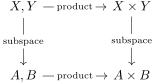
If is a subspace of and is a subspace of , then the product topology on is the same as the topology inherits as a subspace of .
Limit points and convergence
Definition 372.11.
Given , the interior of is defined as the union of all open sets contained in , and the closure of is defined as the intersection of all closed sets containing .
Proposition 372.12.
Let . Then, (closure of in )=(closure of in ).
Proposition 372.13(Munkres (2000) 17.5).
Let .
- iff every open intersects .
- If is a basis for the topology on , then iff every basis element containing intersects .
Definition 372.14(Limit points).
12841cLet , . We say is a limit point of if .
Clearly, , where is the set of all limit points of . Thus, is closed iff it contains all its limit points.
Definition 372.15(Convergence).
is said to converge to if for each neighborhood of , there is a positive integer such that for all .
Continuity
Definition 372.16(Continuity).
is said to be continuous if for each open , is open in .
Clearly, it suffices to show that the preimage of every basis (or subbasis) element is open to prove continuity.
Proposition 372.17.
- is continuous for all .
- The map is continuous if can be written as the union of open sets such that is continuous for each .
Proposition 372.18(The pasting lemma).
Let , where and are closed in . Let and be continuous. If for every , then and combine to give a continuous function .
The product topology
Definition 372.19(Product topology).
Let be an indexed family of topological spaces. Let denote the collection
and let denote the union of these collections,
The topology generated by the subbasis is called the product topology on .
Theorem 372.20.
Suppose the topology on each space is given by a basis . The collection of all sets of the form
where for finitely many indices and for all the remaining indices, will serve as a basis for the product topology on .
Proposition 372.21.
If each space is Hausdorff, then is Hausdorff in both the box and product topologies.
Proposition 372.22.
0adb41Let be an indexed family of spaces; let for each . If is given either the product or the box topology, then
Theorem 372.23.
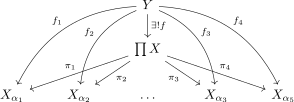
0b2ba1Let be given by in each slot. Let have the product topology. Then, is continuous iff is continuous for each .
Thm 23 is the motivating requirement for the definition of the product topology. Proving requires us to show that each of the projection functions are continuous. It is easily seen that the “product topology” is the coarsest topology that makes this happen. In other words, any topology that hopes to satisfy Thm 23 must contain . In particular, the box topology, being finer than the product topology, also makes the projections continuous. However, the box topology does not satisfy . In fact, while proving , we realize that no topology finer than the product topology works. This is as it should be, since products can be defined using a universal property, and thus should be unique up to isomorphism.
The metric topology
Definition 372.24(Metrizable space).
If is a topological space, is said to be metrizable if there exists a metric on the set that induces the topology of . A metric space is a metrizable space together with a specific metric that gives the topology of .
Proposition 372.25.
d37540Let be a metric space with metric . Define the standard bounded metric by
is a metric that induces the same topology as .
Proposition 372.26.
Let and be two metrics on the set . Let and be the topologies they induce, respectively. Then is finer than iff for each and each , there exists a such that .
Definition 372.27(Uniform metric).
Given an index set , and given points , define the uniform metric on by the equation
where is the standard bounded metric on . The topology induced by is called the uniform topology.
Proposition 372.28.
The uniform topology on is finer than the product topology and coarser than the box topology. These topologies are all different if is infinite.
In the case when is infinite, when is is metrizable in either the box or product topology? Only when is countable and has the product topology.
Proposition 372.29.
Let be the standard bounded metric on . For , define
Then is a metric that induces the product topology on .
In general, it is true that countable products of metrizable spaces are metrizable.
Sequences and continuity
It would be nice if we could say the following: If lies in the closure of subset of the space , then there exists a sequence of points of converging to . This is not true in general, but it is true for metrizable spaces.
Definition 372.30(Countable basis at a point).
A space is said to have a countable basis at the point if there is a countable collection of neighborhoods of such that any neighborhood of contains at least one of the sets .
Note that if has a countable basis at each of its points, is first countable. A metrizable space always satisfies the first countability axiom.
Proposition 372.31(The sequence lemma).
0d769bLet be a topological space.
Let . If there is a sequence of points in converging to , then ; the converse holds if has a countable basis at .
Let . If is continuous, then for every convergent sequence in , the sequence converges to . Then converse holds if has a countable basis at .
Proof.
The forward implication is evident. For the converse, suppose and has a countable basis at . Fix an enumeration for the basis. This gives us a sequence of nested open sets: (these are nonempty since each contains ). Since , we can choose for each . Now suppose is any neighborhood of , with . Since , it follows that contains the tail .
Again, the forward implication is easy. For the converse, show that .□
To show that a space is not metrizable, we can show that the sequence lemma does not hold:
Example 372.32.
c58fc5in the box topology is not metrizable.
We show that the sequence lemma does not hold for using a argument reminiscent of diagonalization using the set and the point .
I’m pretty sure the same idea works to prove that for uncountable under the box topology is not metrizable; just work with a fixed countable subset of .
Example 372.33.
An uncountable product of with itself under the product topology is not metrizable.
Constructing continuous functions
Recall the uniform limit theorem.
Footnotes
-
That this prescription generates a topology should be obvious: is clearly closed under arbitrary unions. For a finite intersection , must lie in for . By definition, there exists a basis element contained in this finite intersection of basis elements. Let . ↩