Absolutely and conditionally convergent series
Definition 153.1.
We say converges absolutely if converges.
For example, converges (by 3.43), but not absolutely. For a first principle proof, consider even and odd groupings of 2 consecutive terms, and see that they individually converge (recall the comparison test):
Let and . Now, triangle inequality to the rescue:
The RHS can be made less than for any . Thus, . So, the sequence must also converge to (which is , btw).
Important
If a convergent series is not absolutely convergent (in which case it is said to be conditionally convergent), we are not at liberty to rearrange the terms. This severely restricts the manipulations we can perform. On the other hand, the limit of an absolutely convergent series is independent of the order in which we sum the terms.
More convergence tests
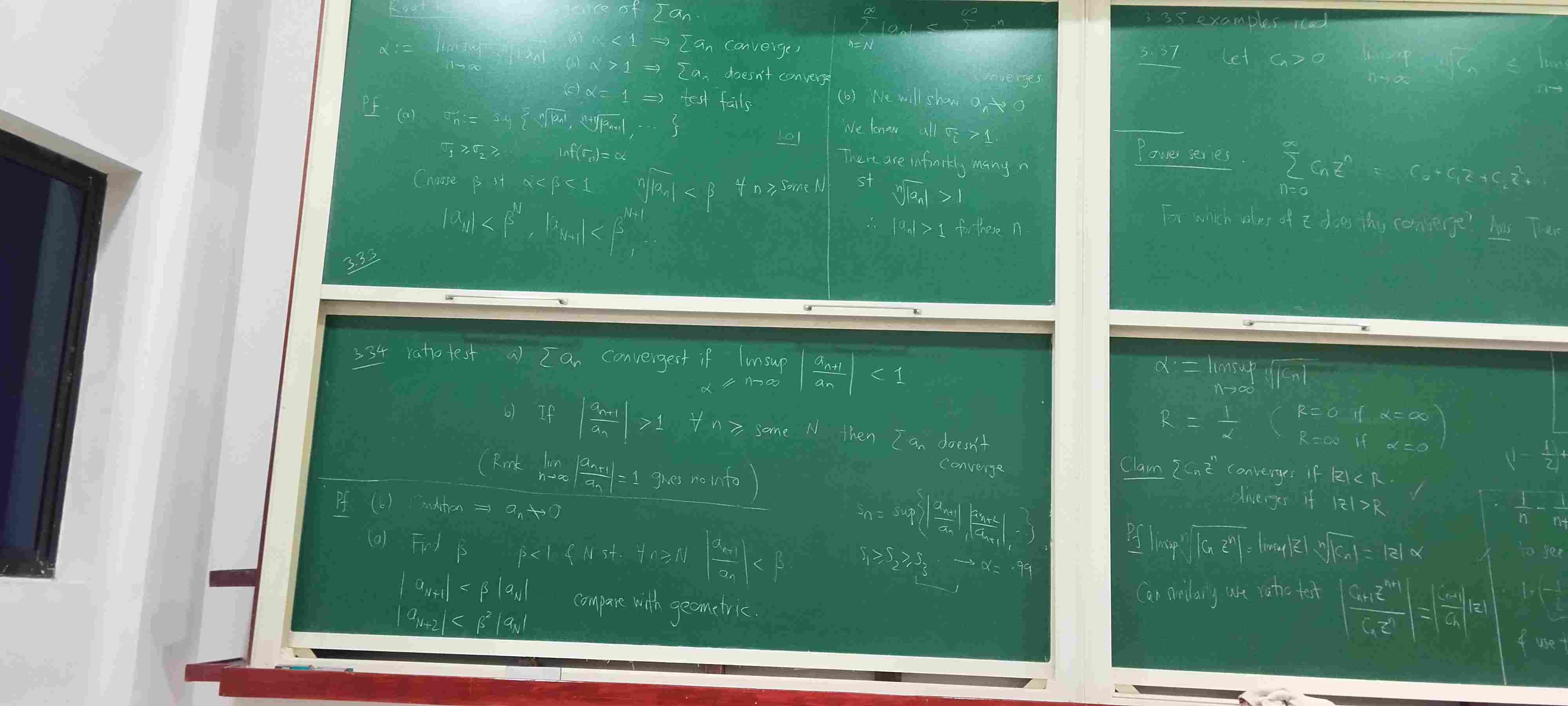
Theorem 153.2(Root test, Rudin (1976) 3.33).
83e84aGiven , define
Then,
if , converges absolutely;
if , diverges;
if , the test is inconclusive.
Proof.
If, pick . We know that there exists such that implies , i.e, . We know converges. Hence, from the comparison test, converges. This implies converges.
If , we know that for all , there exists such that , i.e, . So, .
To prove (3), consider series and . Both have (Rudin, 3.20), but the first diverges, while the second converges.□
Theorem 153.3(Ratio test, Rudin (1976) 3.34).
The series
4. converges if ,
5. diverges if for all , where is some fixed integer.Proof.
If (1) holds, in the same manner as in the previous proof, we can pick such that there exists such that for all , . In particular,
So, for all . The result follows from the comparison test.
(2) prevents the limit of individual terms of the sequence from being 0.□
Warning
Note that for all for some fixed does not guarantee divergence. A counter example can be easily constructed by interlacing two appropriate convergent series.
See Rudin (1976) 3.35 for examples.
Power series
Definition 153.4(Rudin (1976) 3.38).
The power series of a sequence of complex numbers is the series
Theorem 153.5(Rudin (1976) 3.39).
2bd39dGiven the power series , define
If , and if , . Then, converges absolutely if and diverges if . is called the convergence radius of .
Proof.
Remark 153.6.
2ff1e3In Thm 5, the convergence of is uniform on every closed disc of radius centered at the origin, as you can show using Thm 155.12. Thus, it follows that the series converges uniformly on every compact subset of the convergence disc. Uniform convergence on the whole disc fails in general.
Example 153.7.
- The series has , i.e, it converges only when .
- The series has , i.e, it converges for every .
- The above theorem is not easily applicable on the series , since showing takes some work. It is much easier to use the ratio test: , for all . Thus, .
- The series has . If , the series diverges, since does not tend to as .
- Thanks to the limits we proved here, it follows that and have . The former converges for all with magnitude 1 except (TBP). The latter converges for all with magnitude 1 by the comparison test, since ( converges since it is a p-series with ).