Symmetric groups
The set of all permutations of form a group, denoted by . A cycle is a special type of permutation. For example, is what is called a 2-cycle, and represents swapping and . is a 3-cycle, and maps 1 to 2, 2 to 3, and 3 to 1. The group operation is composition. Starting from , they are not abelian.
Lemma 91.1.
Every can be expressed as a product of cycles.
Proof.
Let be the first element in which is not fixed by (i.e, is not mapped to itself. Fixed elements form cycles of length 1). Consider the cycle . Repeat until you have exhausted all elements, at which point can be expressed as a product of disjoint cycles, . Note that the cycles being disjoint makes their product commutative, i.e, we can write the product in any order.□
Now, let the sign of a permutation be defined as the number of “disorders” in the permutation, as done here. Note with this definition, the sign of a permutation is a well defined quantity. It can easily be verified that if a cycle has length , . Thus, if , .
Why is the sign of a permutation well defined, and why is the sign of a product equal to the product of the signs?
First, notice that the number of disorders of a permutation is a well defined number. Also notice that the number of disorders of the identity permutation is 0. Also notice that swapping two adjacent elements changes the number of disorders by . Also notice that swapping any two elements using adjacent swaps takes an odd number of adjacent swaps, and thus changes the number of disorders by an odd number. Let the number of disorders of a permutation be . If we start from the identity permutation and work our way towards by swapping any two elements at a time, notice that regardless of the path we take, the number of swaps we make MUST equal the parity of . For example, if is odd, it is impossible to reach from the identity permutation by making an even number of swaps. Thus, we can safely say that the sign of a permutation is the number of swaps it takes us to get to it from the identity permutation.
Now, composing permutations. Let and be permutations with number of disorders and respectively. Composing them like entails applying first, then (using the convention that function composition is evaluated from the left, to stay consistent with Visual Group Theory). Now, the parity of the number of swaps to get to from is the product of (the parity of number of swaps to get to from ) (the parity of the number of swaps to get to from ), with the latter being the same as the parity of the number of swaps to get to from .
Homomorphisms
Definition 91.2.
Let and be groups. A map is called an homomorphism if
A homomorphism is basically a structure preserving map.
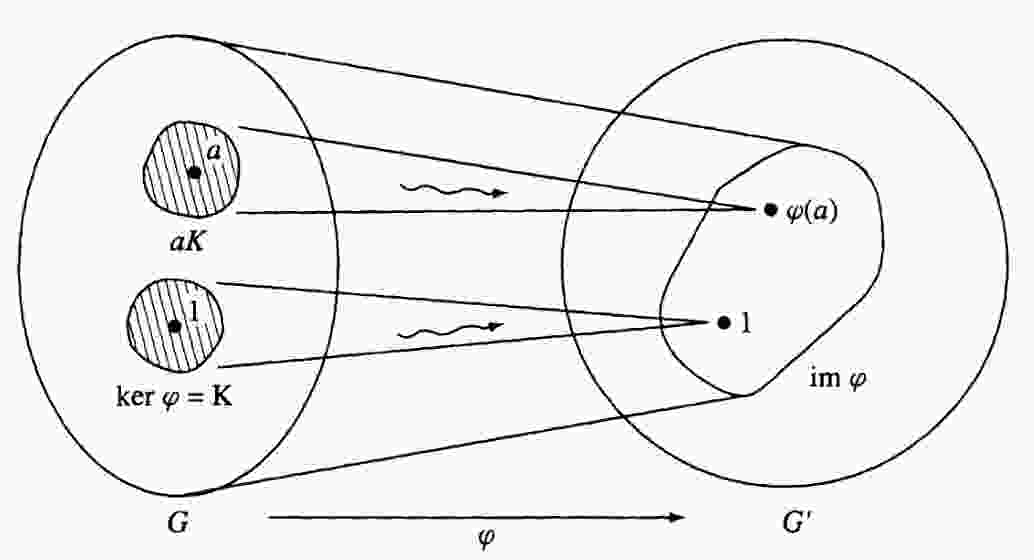
The kernel of is the set of all elements in that it maps to the identity in . The image of is the set of all elements in that have a preimage in .
Theorem 91.3(Properties of homomorphisms).
76946cLet be as defined above. For brevity, we will drop the and symbols.
will always map to .
.
.
Proof.
. It follows that .
Let . Then, . Thus, . , so . Also, , i.e, . Thus, .
Let . There must exist such that and . Then, . Thus, . Obviously, . Also, it can be seen from the proof of statement 2 that . Thus, .□
Note: Actually, , as seen in the next lecture.
Theorem 91.4.
Let be a homomorphism of groups, and let and be elements of . Let be the kernel of . Then, the following are equivalent:
- is in
- is in the coset
- The cosets and are equal.
The last point can be proved by showing that and are subsets of each other.
Theorem 91.5.
Let be the kernel of a homomorphism . The fibre of that contains an element of is the coset of . These cosets partition , and they correspond to elements of the image of .