Eigenvectors and Eigenvalues
Definition 83.1.
6c94b7
- An eigenvector of a linear map is a nonzero vector such that for some scalar .
- An eigenvalue of is a scalar such that the equation has a nontrivial solution.
If for some nontrivial , then we say
- is an eigenvector for , and
- is an eigenvalue for .
Example 83.2.
Let . Consider the vectors .
Notice that . Thus is an eigenvector of .
On the other hand, for any . Thus is not an eigenvector of .
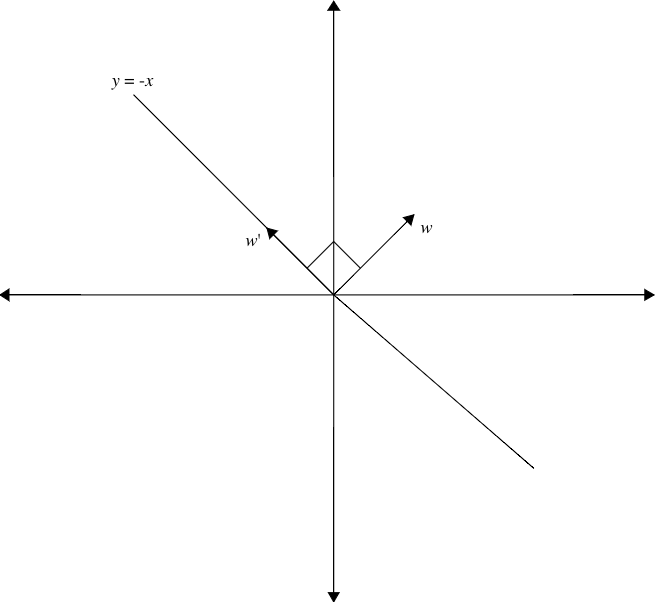
Example 83.3(Reflection).
Let be the linear map that reflects over the line
Consider vectors and , perpendicular to and parallel to respectively.
Notice that is an eigenvector with eigenvalue and is an eigenvector with value .
Example 83.4(Projection).
Let be the projection map that projects a vector vertically onto the -axis. Notice that the vectors lying on the x axis and y axis are eigenvectors with eigenvalues 1 and 0 respectively.
Example 83.5(Rotation).
Consider a rotation map on that rotates a vector by an angle .
In this case we can see geometrically that no eigenvectors exist.
Eigenvectors with distinct eigenvalues are linearly independent
Theorem 83.6.
c1a0c2Let be distinct eigenvalues of , and be corresponding eigenvectors. Then, are linearly independent.
Proof.
FTSOC, assume are linearly dependent. Then, for some , is in the span of . Choose smallest such . This ensures are linearly independent. Since eigenvectors cannot be zero, .
where is obtained by applying on . yields:
which is a nontrivial null linear combination of a set of linearly independent vectors. □
Corollary 83.7.
An matrix has at most eigenvalues.
Eigenspaces
For a given real number and a matrix, how do you
- check if is an eigenvalue of , and
- if yes, find all eigenvectors corresponding to ?
Eigenvectors with eigenvalue , if they exist, must satisfy
This is great, since we already know how to find the kernel of a matrix.
If , then is not an eigenvalue.
Definition 83.8(eigenspace).
Let have eigenvalue . The -eigenspace of is .
Example 83.9.
Let . We want to check if is an eigenvalue.
We can see that is the basis of the -eigenspace of .