Products and Coproducts
has products, and the product of two groups is supported on the product of the underlying sets. Componentwise multiplication defines a group structure on , and it is easy to verify that this group is actually a product in ( Aluffi (2009) II.3.4).
also has coproducts: See Aluffi (2009) Exercises 5.6, 5.7, 8.7.
The nice thing about is that finite coproducts in coincide with finite products.
Proposition 31.1.
8e8d67If and are abelian groups, then the product satisfies the universal property for coproducts in .
Proof.
We need to show that is initial in . Let . We need a unique homomorphism which makes the following diagram commute:
We are forced to define and for all and . Since we require (and every element of can be expressed uniquely as such a product), our definitions determine over its entire domain. So, we have exactly one candidate for . It it a homomorphism?
The marked equality is true since is abelian.□
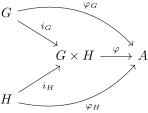
When working as a coproduct, the product of two abelian groups is often called their direct sum and is denoted .
Remark 31.2.
2cc108Products and coproducts are not the same when the index set is infinite.
- The product is the group of all tuples with componentwise addition.
- The coproduct is the subgroup of the product consisting of tuples with finite support.
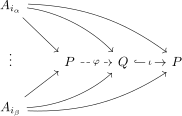
It is easily seen that the prescription in satisfies the universal property of products in .
To prove , let be the subgroup of generated by the images of the . Then the universal property of induces a canonical homomorphism . By extending the diagram to the right by the inclusion , one observes that must be the identity. This forces .
Homomorphisms
Proposition 31.3(Aluffi (2009) II.6.6).
16ae31Let be a homomorphism. Then the inclusion is final in the category of group homomorphisms such that is the trivial map.
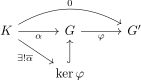
In other words, every group homomorphism such that is the trivial homomorphism factors uniquely though . Note that is just with restricted target.
Monomorphisms and epimorphisms
Proposition 31.4(Aluffi (2009) II.6.12).
79d9eeLet be a homomorphism. The following are equivalent:
is a monomorphism;
;
is injective (as a set-function).
Proof.
: Consider the parallel compositions
where is in the inclusion and is the trivial map. Both and are the trivial map; since is a monomorphism, this implies , which implies .□
The analog of the above statement holds true for epimorphisms: a homomorphism is an epimorphism iff it is surjective. However, Aluffi claims proving epimorphism surjective in is cumbersome, and ==only provides a proof in ==. He does so by defining cokernels in , the universal property for which is obtained by reversing the arrows in the universal property of kernels:
Definition 31.5.
a56a9dLet be a group homomorphism. is the group equipped with a homomorphism which is initial with respect to all morphisms such that .
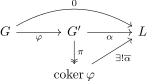
Cokernels exist in because . The condition that is trivial says that , and hence
satisfies the universal property ( is unique because of the universal property of quotient groups).
We can now state the analog of Prp 4:
Proposition 31.6(Aluffi (2009) II.8.18).
1e7b58Let be a homomorphism of abelian groups. The following are equivalent:
is an epimorphism;
is trivial;
is surjective (as a set function).
Proof.
: Consider the parallel compositions
where is the canonical projection. Both and are trivial, which implies , which implies .□
Remark 31.7.
fc94afThe problem in is that is not guaranteed to be normal in . However, cokernels may still be defined in : the universal property is satisfied by , where is the smallest normal subgroup of containing . But Prp 6 fails, because the implication fails.